In ‘70s Moscow, a lot is on the line in the lead-up to a visit from Secretary of State, Henry Kissinger. So when two gay men, one of them an American, are brutally murdered, the KGB is keen on solving the crime right away. Viktor Moroz, an engineer waiting to leave for Israel, becomes an easy suspect. He can earn his freedom if he solves the crime. Ample doses of real history such as the Helsinki Agreement, are tucked into a vivid portrait of Moscow. The nonlinear plot lines leave frayed threads but the travelogue and snappy dialog compensate somewhat.
Thursday, July 6, 2023
The Cat Who Saved Books by Sosuke Natsukawa
Teenager Rintaro Natsuki is a hikikomori, a nerdy introvert who would like nothing better than the company of books. But the bookstore he inherits from his grandfather is dying and the teen must accept its inevitable fate. Or must he? One day a tabby cat appears at the bookstore pleading for Rintaro’s help: books are being mistreated and the teenager and his friend can help. The three set off on a series of such adventures (entering “labyrinths”) and the charming ending wraps up endearingly if a tad predictably. A warm and inviting story that will please ardent book lovers everywhere.
Friday, June 9, 2023
The Great Reclamation by Rachel Heng
With the ocean as their backyard, Ah Boon and his classmate Siok Mei grow up in land that becomes Singapore. Siok Mei gets swept up in anti-government activities but Ah Boon, having seen his own father lost to government atrocities, treads a narrow path. He joins the Gah Men, the repressive government authorities who doggedly destroy the seaside villages to create a new Singapore as part of the Great Reclamation. The two lovers’ paths are not linear and their motivations are not unselfish either. Heng shows a remarkable knack for juggling nuance and human complexity in a spectacular must-read debut.
Tuesday, June 6, 2023
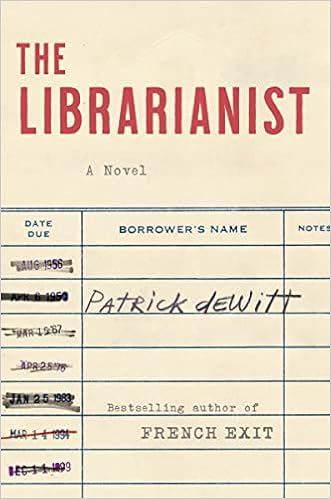
The Librarianist by Patrick deWitt
“Part of aging, at least for many of us, was to see how misshapen and imperfect our stories had to be.” Librarian Bob Comet’s life has been misshapen by a singular tragedy: his wife Connie leaves him for his best friend, Ethan. Tracing the extraordinary story of an ordinary life, deWitt visits Bob in his retirement and back to a segment of his boyhood when he runs away from home. Heartwarming without eye-rolling manipulations is difficult but DeWitt delivers. An unsplashy marvel that celebrates the quotidian and highlights the many joys and scars tucked into the arc of a life.
Monday, June 5, 2023
The Best Possible Experience: Stories by Nishanth Injam
Injam captures the heartache of immigration without sappiness and includes ample doses of dark humor. In the story “Summers of Waiting,” a granddaughter returns to India from Chicago to care for her elderly grandfather, whose life is ravaged by guilt. In “The Protocol,” an Indian immigrant and a down-on-her-luck Black woman agree to marry to get a green card in exchange for money. Humor abounds as well: All hell breaks loose when 12-year-old Vikas invites his classmate over for lunch, completely befuddling his poor parents. Filled with sharp humor and unafraid of humanity’s dark underbelly, this is a promising debut.
Saturday, June 3, 2023
The Fraud by Zadie Smith
The imprint of colonialism in Jamaica is one of the central themes of Smith’s novel which seeks to explain the meaning of authenticity. Mrs. Eliza Touchet, the abolitionist housekeeper of a Victorian home in eighteenth-century England, sees that integrity varies depending on who’s worth is being measured. The novel’s noble intentions are not enough to see the plot through as it gets tied up in multiple strands that stall momentum. The established authors featured here lack authenticity, foregoing lived experiences for glamorous stories that push copies. To them it doesn’t matter that “the poor don’t need literature, they need bread.”
Monday, May 29, 2023
Paved Paradise: How Parking Explains the World by Henry Grabar
Ignore the hyperbole tucked into the clever cover art. Parking does not explain the world but it does exacerbate socioeconomic inequality and exposes the problems of a car-centric culture. “Sooner or later, the commuter would have to get out of his car. He could leave it at home and take the bus. He could do it on the edge of a pedestrian downtown, though not without a handful of enormous public garages. Or he could do it in a privately held lot, right in front of his destination. In most American cities, that last option is more or less how things worked out.” A must-read.
Subscribe to:
Comments (Atom)